
Cervical Disc Replacement
(Artificial Disc Surgery)
Motion-Preserving Surgery for Nerve Compression in the Neck
Quick Summary
Cervical disc replacement is a surgical procedure used to treat nerve compression in the neck while preserving motion at the treated level of the spine.
Used to treat cervical disc herniation and nerve compression
The damaged disc is removed and replaced with an artificial disc implant
Designed to maintain motion in the neck
Often improves arm pain, numbness, and weakness
May reduce stress on nearby spinal levels compared with fusion
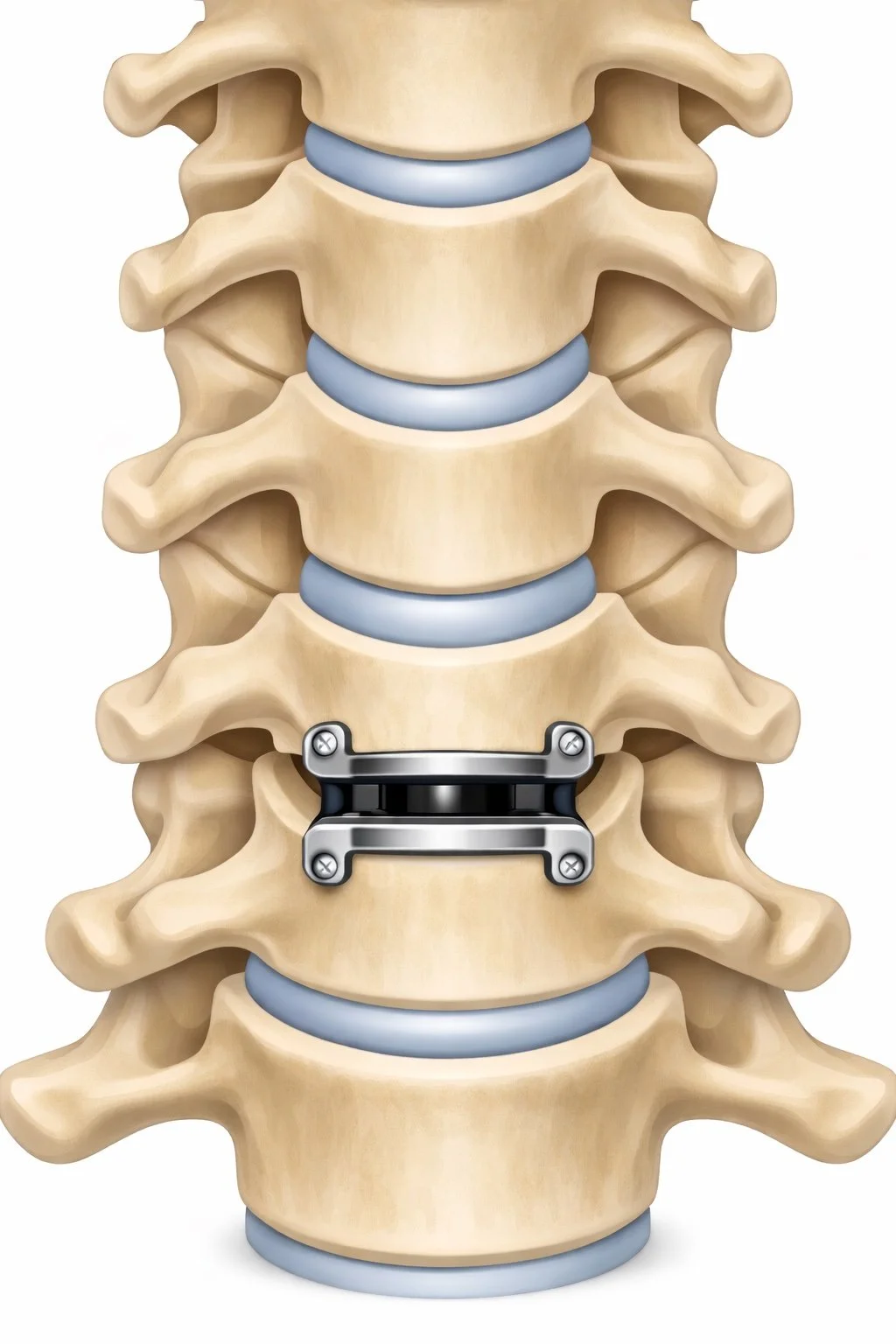
What Is Cervical Disc Replacement?
Cervical disc replacement, also called artificial disc replacement, is a surgical procedure performed to treat nerve compression in the cervical spine.
During the procedure:
The damaged disc is removed from the neck.
Pressure on the spinal nerves or spinal cord is relieved.
The disc is replaced with an artificial disc implant designed to maintain motion between the vertebrae.
This procedure is performed through the front of the neck, similar to the approach used in ACDF surgery.
Unlike spinal fusion, which joins two vertebrae together, disc replacement is designed to preserve movement at the treated level of the spine.
When Is Cervical Disc Replacement Recommended?
Cervical disc replacement may be recommended for patients with nerve compression caused by a damaged cervical disc.
Common conditions treated include:
Cervical disc herniation
Cervical radiculopathy (pinched nerve in the neck)
Degenerative disc disease causing nerve compression
Patients are typically considered candidates when:
Arm pain, numbness, or weakness persists despite treatment
Imaging confirms a disc problem compressing a nerve
The spine remains stable and properly aligned
Not all patients are candidates for disc replacement, and careful evaluation is necessary.
How Is Cervical Disc Replacement Performed?
Cervical disc replacement is performed through a small incision in the front of the neck.
During surgery:
The surgeon carefully moves aside muscles and structures in the neck.
The damaged disc is removed.
Bone spurs or structures compressing the nerve are removed.
An artificial disc implant is placed between the vertebrae.
The implant is designed to allow controlled motion between the vertebrae while maintaining stability of the spine.
The procedure typically takes one to two hours, depending on the number of levels treated.
Benefits of Cervical Disc Replacement
Potential benefits of disc replacement include:
Relief of arm pain and nerve symptoms
Improvement in numbness and tingling
Preservation of motion at the treated level
Maintenance of more natural spine movement
Potential reduction of stress on nearby spinal levels
Many patients experience significant improvement in arm pain and nerve-related symptoms after surgery.
Cervical Disc Replacement vs ACDF
Both cervical disc replacement and ACDF are effective treatments for nerve compression in the neck.
The key difference is how the spine is stabilized after the disc is removed.
ACDF (fusion):
The vertebrae are fused together.
Motion at the treated level is eliminated.
This is a very well-established and commonly performed procedure.
Cervical Disc Replacement:
The damaged disc is replaced with an artificial implant.
Motion at the treated level is preserved.
Your surgeon will determine which procedure is most appropriate based on the specific condition of your spine.
Recovery After Cervical Disc Replacement
Recovery after cervical disc replacement is similar to other cervical spine procedures.
Typical recovery includes:
Walking soon after surgery
Many patients returning home the same day or after one night in the hospital
Gradual return to normal daily activities
Avoiding heavy lifting early in recovery
Many patients are able to resume normal activities within several weeks, although recovery varies between individuals.
Risks and Considerations
Cervical disc replacement is generally safe, but all surgeries carry some risks.
Possible risks include:
Infection
Bleeding
Nerve irritation
Implant complications
Persistent symptoms
Your surgeon will review the risks and benefits based on your individual condition.
When Should Cervical Disc Replacement Be Considered?
Disc replacement may be appropriate when:
Nerve compression causes persistent arm pain, numbness, or weakness
Non-surgical treatments have not provided sufficient relief
Imaging confirms a disc problem compressing a nerve
The spine is stable and suitable for a motion-preserving procedure
When performed for the correct indications, cervical disc replacement can provide excellent relief of nerve symptoms while maintaining spinal motion.
Most Commonly Asked Questions
-
An artificial disc is a medical implant designed to replace a damaged spinal disc while allowing motion between the vertebrae.
-
Both procedures are effective. The best option depends on the patient’s specific condition and spine anatomy.
-
The goal of disc replacement is to maintain motion at the treated level, although overall neck movement can vary between individuals.
-
Artificial discs are designed to be durable implants, and many patients maintain good function long term.
-
In certain cases, disc replacement can be performed at more than one level, depending on the patient’s condition.

When should I see a spine specialist?
You should seek evaluation if you have:
Neck or arm pain persists despite treatment
You develop weakness, numbness, or coordination problems
Symptoms that interfere with daily activities
Early evaluation can help guide appropriate treatment.